Our Location
Unit F1, 6/F, Kaiser Estate Phase 1, 41 Man Yue Street, Hung Hom, Kowloon, Hong Kong

Unit F1, 6/F, Kaiser Estate Phase 1, 41 Man Yue Street, Hung Hom, Kowloon, Hong Kong

Three metals cover almost every wholesale brief we quote: 925 sterling silver, brass and copper, and solid K gold in 8K, 9K or 14K. Each one carries plating differently, sits at a different price point, and suits a different kind of collection. This page explains which is which, and what to write on a spec sheet so the second order matches the first.
The same CAD can be produced in all three. The decision usually comes down to the retail price you need to hit and how the piece will be worn.
92.5% silver alloyed with copper for hardness. Takes both gold-tone and rhodium plating beautifully, carries real metal value your customer can recognise, and is the accepted precious metal of the accessible-luxury segment. Our default for brands moving up from fashion jewellery.
Brass is our highest-volume production metal — most of our plated lines run in brass. It is light, casts fine detail, and plates to a convincing gold or rhodium finish at a price that supports volume retail. Red copper is available on request for warmer solid-copper and enamel work.
Solid gold alloy, not a plating over base metal. 8K and 9K suit price-sensitive European programmes; 14K is the standard for US and premium capsules. Priced by metal weight and quoted against the live gold price, so the figure moves with the market rather than being held inside a round number.
Plating life is decided by three things: the thickness applied, the quality of the polish underneath it, and how the piece is worn. We control the first two and document them.
The warm, high-perceived-value look, and our default for gold-colour programmes on silver and brass. Colour matched to an approved reference sample.
Bright white, hard-wearing and tarnish-resistant. Standard for white-metal collections and for silver pieces that need to stay bright in a display case.
Rose-tone and other finishes are quoted per project, with the colour approved on a sample before production.
The default finish: hand and mechanical polishing to a mirror before plating. Best for classic and bridal styles.
A softer, lower-sheen surface that hides fine scratches in daily wear. Available on request.
Hammered, stippled and carved surfaces finished at the bench, for designs where the texture is the point.
| Stone | Typical use |
|---|---|
| Cubic zirconia | The workhorse for colour and sparkle at volume. Set by hand in prong, bezel and pavé arrangements. |
| Pearl | Freshwater pearls, set or mounted with adhesive-free fittings where the design allows. |
| Enamel | Colour fills and decorative panels, applied and cured in-house. |
| Coloured & lab-grown stones | Quoted per project. Grade and size are agreed before sampling so the price and the look stay connected. |
Stone grade is part of the spec sheet. If a quotation looks unusually low, check the stone grade before comparing it with another supplier.
A sample that has been in a box for a week tells you very little. These are the checks we run, and the ones you can run yourself when a sample arrives.
A number in microns, measured on the finished part. “Heavy plated” is not a specification.
Plating wears first where the surface curves. Look at prong tips, ring edges and clasp corners under a lamp.
A white cloth rubbed firmly on a plated piece should not pick up colour. If it does, the layer is thin.
The only reliable way to compare batch two with batch one is to keep a piece from batch one, in the same conditions.
Metal content is SGS-tested. Plated finishes are RoHS-compliant, with EN 1811 nickel-release testing for items intended for prolonged skin contact. Testing also covers GB 11887-2012 and QB/T 1135-2006 coating thickness. Reports can ship with the goods; ask for them on the purchase order.
More detail in Quality Control & Material Testing.
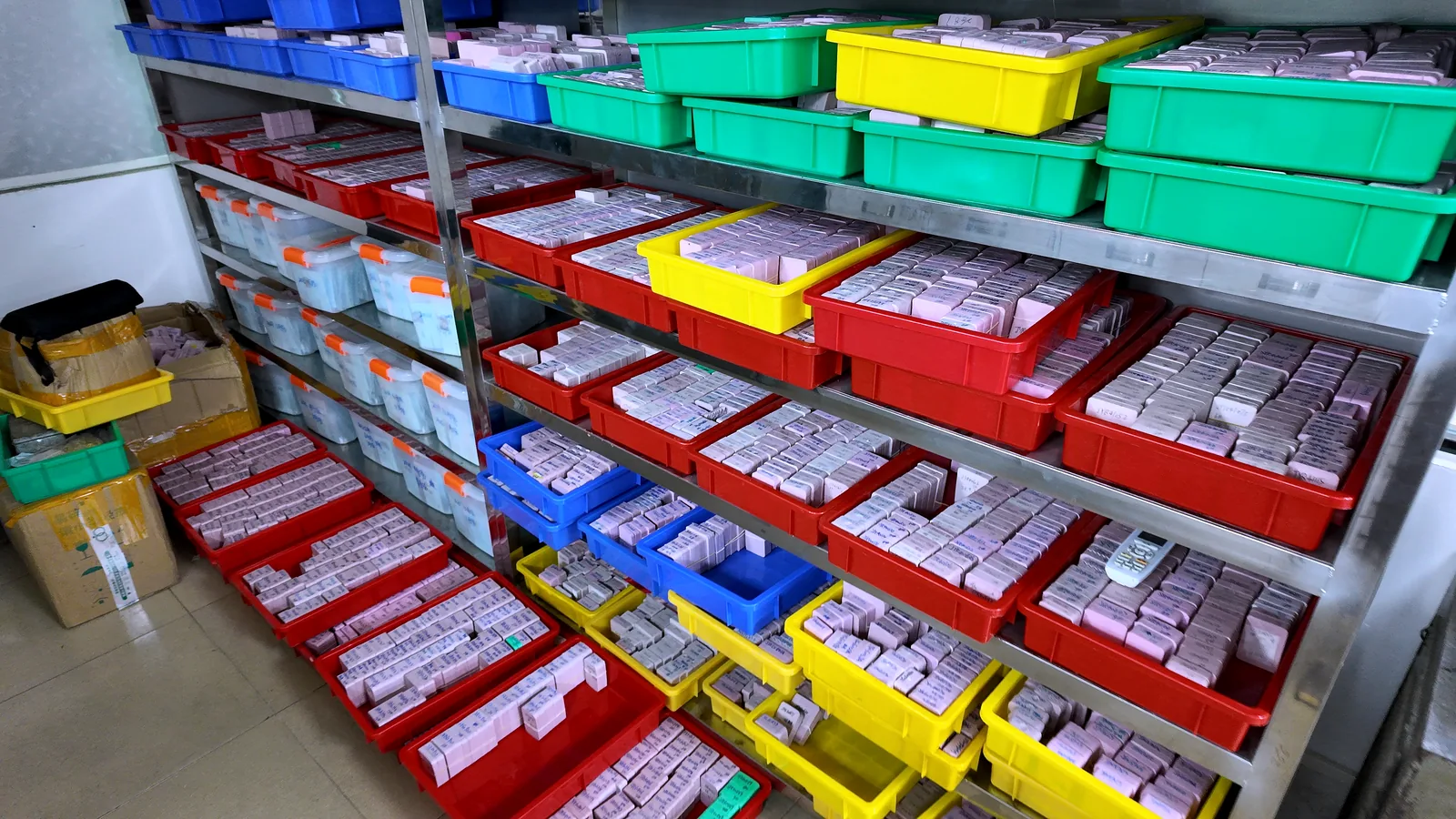
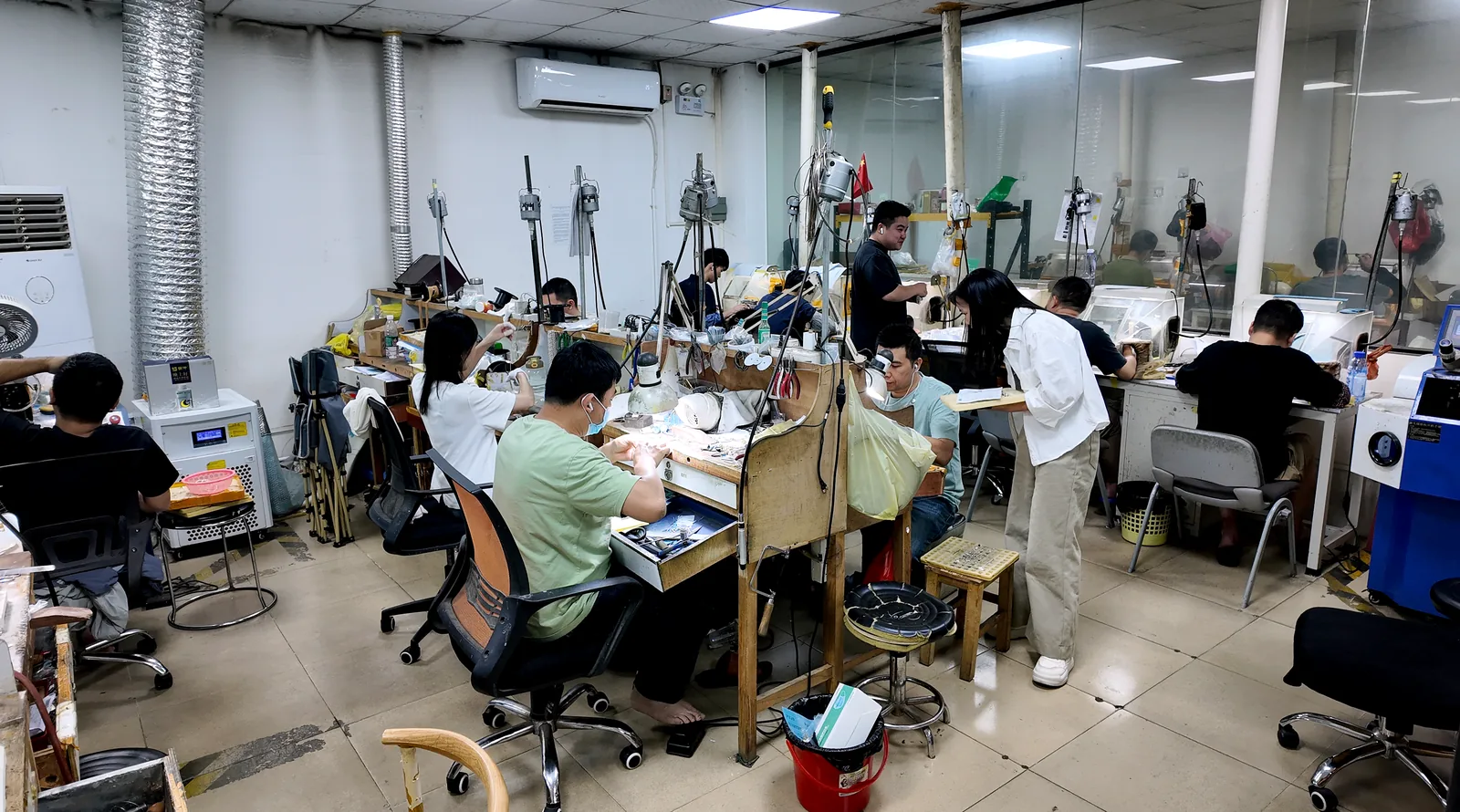
Two views from the workshop behind these options: the component stock each material choice is cut from, and the finishing stations where the surface the plating sits on is produced.
Send the retail price you need to hit and the look you want. We will come back with the metal and finish combination that gets you there without overshooting the brief.